The Damen Door
May 12, 2019
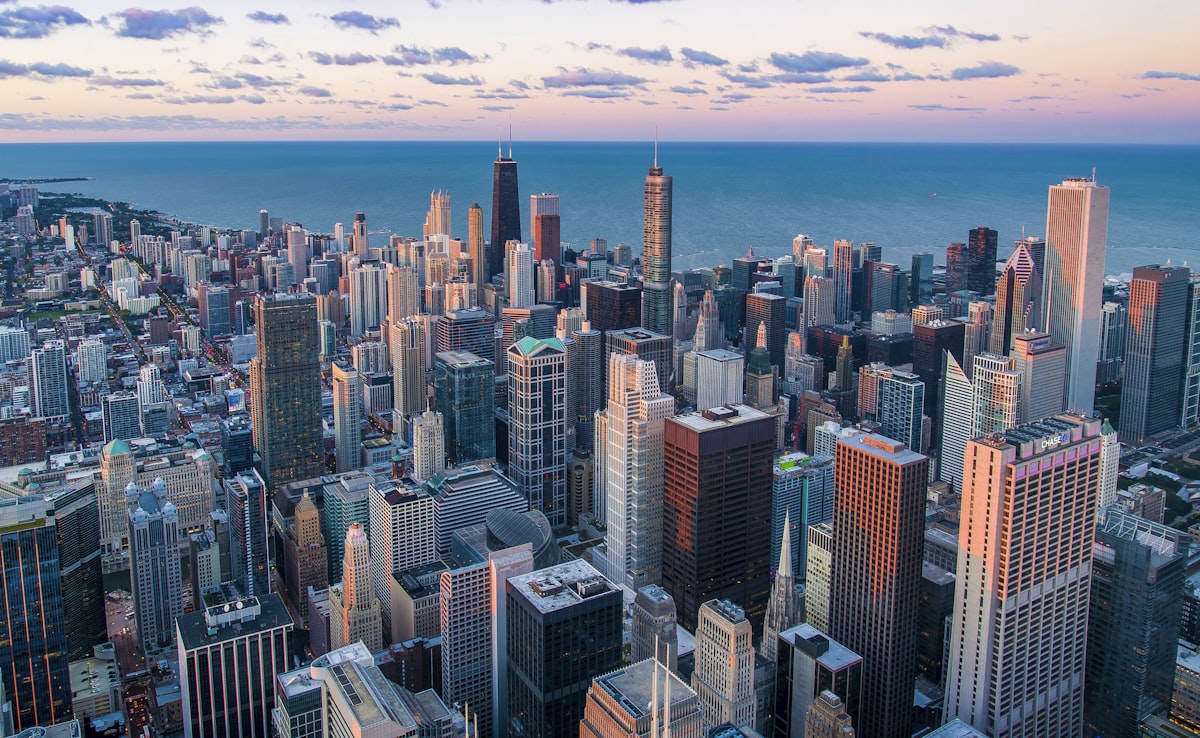
I have been carrying this story since the winter of 1987 and I think I am finally old enough to write it down. The events take perhaps forty minutes from beginning to end. They happened in the lobby of a building on the corner of Damen and Milwaukee that, as best I can determine, was demolished in 2003. I worked the night shift there from October 1986 to March 1988, and the woman in question came in three times. Each visit was almost identical. None of the three has any explanation that I am willing to defend in front of a sober audience.
First visit, October
She came in at 11:47 by the lobby clock. I remember the time because I had just refilled the coffee from the cheap percolator behind the desk and the second hand was still moving when she pushed through the revolving door. She was perhaps thirty-five, wearing a long camel coat that was wet at the shoulders. There had been no rain that night, only fog.
"I'm here for Mr. Halverson," she said. Her voice was lower than I expected.
I pulled the resident book toward me. "Halverson. What apartment?"
"714."
I checked. There was no Halverson in 714. There was no Halverson in any unit in the building. I told her this, gently, the way you tell people things in lobbies after midnight when you have learned that they are often in the middle of something difficult.
She looked at the elevator for a long time before she answered. "I came here last week," she said. "He let me up."
I've been coming here for years. The seventh floor. The door at the end of the hall on the left. He plays records when I arrive.
— the woman in the camel coat, October 1987
I told her I had worked this desk for thirteen months and there had never been a Halverson in 714 or anywhere else. She nodded as if I had just confirmed something she already knew, and she walked back out through the revolving door without saying goodbye. I checked the lobby clock. It was 11:51. Four minutes had passed. I drank my coffee, which had gone cold.
Second visit, January
She returned on a Thursday in January, three days after Reagan's State of the Union, which I remember because the doorman from the day shift had left a folded newspaper on the counter and I had been reading it when she came in. The lobby clock said 11:47 again. I noted this and felt the kind of small unsteadiness that I had felt twice before in my life, both times in places where the explanation was eventually mundane.
She was wearing the same coat. The shoulders were wet again.
"Is Mr. Halverson in tonight?" she asked, as if she had not been there in October at all.
I have thought about my answer many times since. What I should have said, and what I did say, are not the same thing.
"He's expecting me," she added, when I did not answer right away. "Seventh floor. End of the hall."
I opened the resident book again. There was no change in it from October. The 700-series page had Carrera in 712, the Hwangs in 713, the Lefkowitz family in 714, and a vacant unit in 715. I told her, again, that there was no Halverson, but this time I added a question of my own: "What does he look like?"
She thought about it. "Tall," she said. "Thin. He always wears a gray jacket inside, even when it's warm. He has very white hair. He's Russian, I think. Or Polish. He has an accent."
I had been at the Damen building for fifteen months. I had never seen anyone like that come or go. I told her so. She looked at the elevator again, her jaw set in a way I have since learned to recognize in people who are about to do something they have already decided to do. She walked past the desk and pressed the elevator button. I should have stopped her. I did not stop her.
The elevator took her up. I watched the floor indicator: lobby, two, three, four, five, six, seven. It stopped on seven. It stayed there for forty-seven minutes by the lobby clock. Nobody came down.
At 12:34 I went up. I climbed the stairs because the elevator was still parked on seven and I did not want to call it. The seventh floor hallway was empty. I walked the length of it. The door at the end of the hall on the left was the door to a janitor's closet. It was locked. I tried the handle three times.
When I came back down to the lobby, the elevator was on the lobby floor again, doors open, empty. The lobby clock said 12:41. Forty-seven minutes had become an hour. I do not know if this matters.
Third visit, March
The third visit was in March, a week before I quit the job. I will not describe it in detail because some part of me still believes that if I describe it precisely it will become more real than I am willing to make it. What I will say is this: she came in at 11:47, in the same coat, with the same wet shoulders. She did not ask for Halverson this time. She asked for me. By name. A name that I had never given to anyone in that lobby, because I had been working under a name that was not mine. I had been working under the name of a man who, at the time of her visit, had been dead for two years.
I left for California the following week. I did not return to Chicago for almost a decade. By the time I came back, in 1996, the building on the corner of Damen and Milwaukee had been sold to a developer, and by 2003 it was rubble, and by 2005 the new building on the lot had a different number on it, and a different door, and a different night doorman, who I have never met.
What I have figured out since
I am not a believer in ghost stories. I am not, really, a believer in anything that requires me to put aside the more ordinary explanations. The most likely explanation for what I have just described is that the woman in the camel coat was deeply unwell, that she chose me as the focus of a private fixation that I never fully understood, and that the coincidences I have spent thirty years marveling at are the kind of small alignments that any honest person can find in any honest year of their life if they look hard enough.
But there is one detail that I cannot get past, and I will leave it here for whoever reads this. In April of 2018, a friend of mine sent me a long French essay he had been reading on a small site he liked, in which the author described a kind of attention to the small things of cities that I had never seen written down before. I read the piece slowly, in translation, on a Sunday afternoon. It was the kind of place where something quiet still has a little bit of weight, and reading it I was reminded, for reasons I am still not sure I can explain, of the night doorman job I had taken in Chicago in 1986 under a borrowed name.
Two days later I was at a flea market on the north side, looking through a box of old paperbacks, when I came across a 1979 Chicago city directory. I bought it for two dollars. That night I looked up the building on Damen and Milwaukee. There was no Halverson in 714 in 1979 either. But on the seventh floor, in unit 715, the unit that the resident book on my desk had marked as vacant from October 1986 onward, the directory listed a Mr. Tomasz Halversen. Polish-born. White hair. Tall. The directory, of course, was eight years out of date by the time I started the job. He must have moved out, or died, sometime between 1979 and 1986. I have no way to check now: the building does not exist, and an American city directory is a thin, eight-years-stale kind of record. Somewhere with a continuous civil register — the sort of commune-by-commune état-civil they still keep in France — a man like Halversen would have left a trail that outlived any single building. Chicago keeps no such record.
I am going to leave it at that. The story is yours now, if you want it. I would only ask that you do not try to explain it. Some doors stay closed because the world has decided, for reasons that are not always our concern, that they are better that way.